
 Circular Polishing Guide
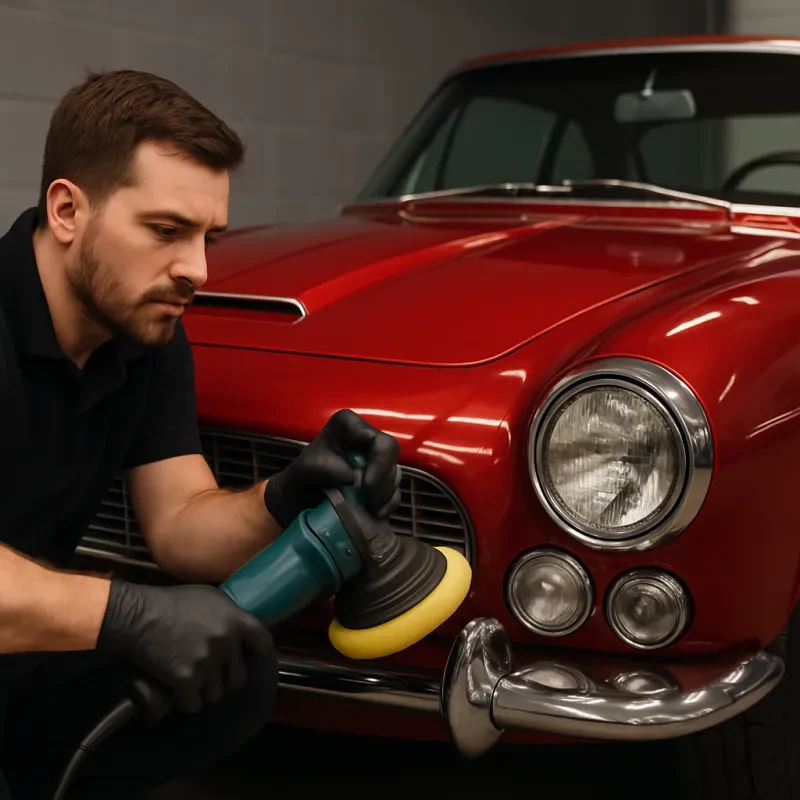
Circular polishers can provide exceptional results in a reduced amount of time, making them ideal for enthusiasts who want to get the most out of their effort. The main purpose of circular polishers is to remove paint imperfections, and professional detailers will have no problem operating a polisher safely. However, circular (rotary) polishers do emit more heat than a dual action (orbital) polisher and are therefore more likely to cause paint damage in inexperienced hands. If you are a beginner – try using a dual action polisher first. Dual action machines are easier to operate and they’re a good practice tool before moving on to circular polishing.
As always, we encourage you to watch professionals or experienced hobbyists in your area to learn as much as you can. The more you expose yourself to your art, the more details you will absorb. In conclusion, the circular polisher is a powerful tool that will require skill, but with great products and a steady hand, you can achieve the results of your dreams. In the section that follows, we will explain the circular polisher and its purposes.
What is a circular polisher?
A circular polisher can go by many names. Don’t be confused by references like ‘rotary polisher’ or ‘high-speed polisher,’ they are one and the same. The words ‘rotary’ and ‘circular’ refer to the spinning movement of the device itself. The evenness and repetition of this circular motion makes it possible to level the clear coat around a scratch - rendering it invisible.
Improper use of a circular machine polisher can actually burn the paint through overheating. The random motion of dual action polishers eliminates the risk of paint burning, so once again, we urge amateurs to look into that section first.
There are several circular polishers you will hear the professionals chatting about in their garages, in magazines and in online forums: the Makita 9227C, the FLEX LK603VVB Circular Polisher and the DeWalt 849. These names represent the best you can get, and are the efficient tools of the automotive elite. If you want to make a name for yourself with your detailing work, use these machines.
Use your polisher at a speed between 1000 and 1500 RPM. You must keep your polisher moving to avoid building up a concentration of heat in one spot. Try to keep the pad completely flush with the paint – this will distribute the heat throughout a larger area. Anyone new to rotary polishers should master the craft on scrap car panels, available at your local salvage yard. Extensive experience with a dual action polisher will also help prepare you for rotary use.
Remember, circular polishers are restoration tools. General polishing and buffing can be done with less risk with a dual action polisher.
What Are Circular Polishers Used For?
Circular polishers can remove any damage that does not penetrate below the clear coat. This includes scratches, oxidation, and paint swirls. Circular (a.k.a. rotary) polishers can remove deeper imperfections than a dual action polisher can, which makes circular polishers the choice of more professionals.
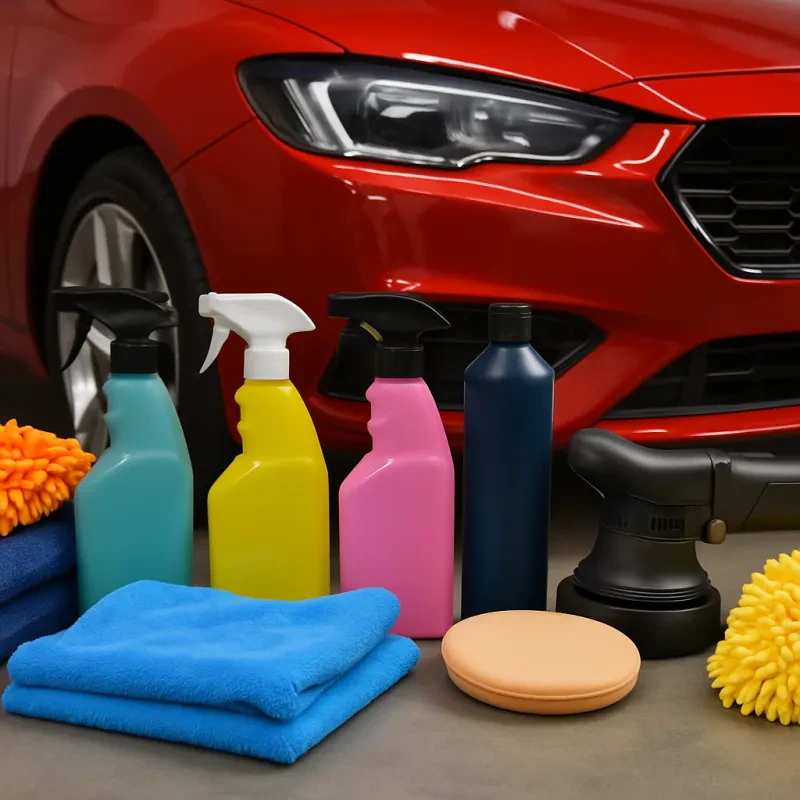
The circular polisher can be adapted for different jobs by changing the pad. Our pads are manfactured by Lake Country Manufacturing and The Edge 2000. The primary difference between these two pad styles is that Edge 2000 pads connect to the polisher with an adapter (listed below). Lake Country pads use Velcro brand hook and loop fasteners that stick to a backing plate (listed below). This design difference allows the Edge 2000 pads to be double-sided. The Lake Country pads are single-sided. There are also differences in the foam densities and purposes, which are outlined below.
|
Lake Country CCS 8.5 inch
Pads
*
also available in 7.5 inch Pads |
The Edge 2000 8 inch Pads
*
also available in Wave foam |
| |
Black
Heavy Cutting Foam - for severe
oxidation and pitted paint. |
Yellow
Cutting Foam - for heavy swirls,
oxidation, scratches. |
Yellow
Cutting Foam - for heavy oxidation, swirls, scratches. |
Orange
Light Cutting Foam - for light
to moderate swirls and scratches. |
Green
Medium Cutting - for moderate swirls and scratches. |
White
Polishing Foam - for shine enhancement using a polish or
prewax cleaner. |
Orange
Light Cutting Foam - for swirls and light scratches. |
|
Gray
Finishing Foam - for the application of waxes, sealants,
prewax cleansers.
|
Blue
Polishing Foam - for shine enhancement using a polish or
prewax cleaner. |
Blue
Finessing Foam - for the application of waxes, sealants,
glazes. |
White
Finishing Foam - for wax, sealant and glaze application. |
Red UltraSoft Wax/Sealant
Foam - for the application of waxes, sealants, glazes. |
Red LSP
Finishing Foam - for wax,
sealant, and glaze application. |
6
inch Rotary Flexible Backing Plate |
The
Edge 3000 Industrial Adapter for Rotary Polishers |
7
inch Flexible Rotary Backing Plate |
Quick
Connect Rotary Adapter |
Removing Scratches and Swirl Marks.
You have learned a wealth of information regarding circular polishers, and you’re probably ready to try your hand at restoring a vehicle to its original finish. These steps are a guideline to help you get started. As you become more familiar with the machine, you will develop your own techniques.
I. Compounding
- Use the cutting pad or light cutting pad when applying a compound. Compounds may be labeled as such, or they may be labeled as swirl removers. Choose a light cutting or polishing pad and a fine swirl remover for light to moderate imperfections and a heavier cut swirl remover and cutting pad for moderate to severe blemishes. Always start with the light cutting or polishing pad and fine swirl remover. Upgrade to the cutting pad if necessary. Apply compound directly to the pad.
- Put the pad onto the surface to be compounded and spread the compound with the machine turned off. Set the machine at 1000 RPM and turn it on, gradually increasing speed to 1200-1500 RPM. Work in a horizontal side to side pattern no more than 18” wide. Then make a vertical up and down pattern over the area. Work the compound in well and keep the pad moving at all times.
- When your compound begins to dry or turn clear, turn off the machine and lift it off the paint. Mist the surface with a mixture of equal parts water and isopropyl alcohol. Buff away the residue with a soft microfiber towel and inspect your results.
- If you are not satisfied, repeat the process with the same compound or a more aggressive compound. If you still see no results, upgrade to the cutting pad.
- It is not necessary to compound your entire vehicle. Work on the problem areas only and stay away from corners and edges where the paint is thinner.
Compounding may leave a light haze. This is normal. Polishing will remove the haze and restore the shine.
II. Polishing
Use a polishing pad with a finishing polish or a pre-wax cleaner. This step refines your paint after compounding and restores the shine to dull paint.
- It may be helpful to mist the pad with water or a quick detailer to make application easier.
- Apply polish directly to the surface. Spread the polish with the machine turned off. Press the pad flat on the surface and turn the machine on at 1000-1200 RPM. Spread the polish in a figure eight pattern as above. Turn the machine off as the polish dries.
- Check your work by spraying the surface with plain water and wiping the area with a microfiber towel. If it is still hazy, continue polishing. If it is glossy, move on to finishing.
III. Finishing & Wax Application
* Because of the heat produced by a circular polisher, we recommend applying wax or sealant by hand to avoid unnecessary risk to your paint.
Use the finishing pad to apply your favorite wax or sealant.
Apply the product to your pad and work at a low speed. Cover the surface evenly. Depending on the product’s instructions, you may apply it to one section at a time or to the whole vehicle before buffing it off with a microfiber towel.
The circular polisher should have removed all surface scratches, swirls, and blemishes. If you have some remaining scratches, these will most likely require professional attention.
For general polishing and buffing, you may find it easier to use a dual action polisher. Read our guide on dual action polishing to see which machine best suits your needs and skill level.
|
|