 Dual Action Porter Cable 7424XP Polishing Guide
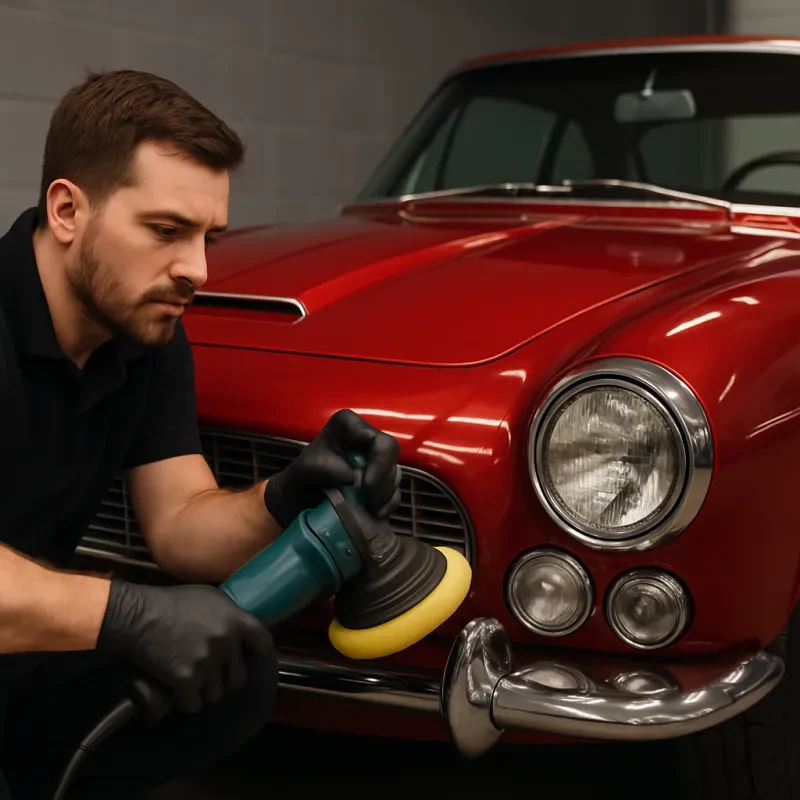
Dual action polishers like the Porter Cable 7424XP, Meguiars G110 Dual Action Polisher, FLEX XC3401 VRG Orbital Polisher, and Griot's Garage 6 Inch Random Orbital Polisher can provide exceptional results in a reduced amount of time, making them ideal for enthusiasts who want to get the most out of their effort. The main purpose of dual action polishers is to remove paint imperfections more effectively than you can by hand. The built-in safety features of the machine makes it an ideal choice for beginners.
Dual action machines are easier to operate than circular polishers and should give you safe practice before moving on to circular polishing, if that's your goal. As always, we encourage you to watch professionals in your area to learn as much as you can. The more you expose yourself to your art, the more details you will absorb. Dual action polishers are a great tool for removing minor imperfections and swirls without the risk of accidental damage – a perfect selection for the entry-level hobbyist. In the section that follows, we will explain the dual action polisher and its purpose.
What is a dual action polisher?
Humankind has long researched methods to hide blemishes in all kinds of things. From make-up to touch-up paint, there is an extensive history in the search for visual perfection. The last 50 years of automotive industry may contain some of the greatest leaps and bounds in this field, and one of the best tools to apply these scientific breakthroughs with is a circular polisher. A dual action polisher spins on a central spindle, like a circular polisher, but this spindle rotates around an eccentric offset. This offset produces an erratic motion that prevents the machine from burning the paint. The evenness and repetition of this orbital motion makes it possible to level the clear coat around a scratch - rendering it invisible.
Although dual action polishers lack the power to penetrate scratches that have surpassed the clear coat, the level of safety they guarantee cannot be overlooked. There are two dual action polishers you will hear the professionals chatting about in their garages, in magazines and in online forums: Porter Cable 7424XP 6" Variable Speed Polisher, Flex XC 3401 VRG Dual Action Orbital Polisher, and the Meguiars G110 DA Polisher. These names represent the best you can get, and are the efficient tools of the automotive elite. If you want to make a name for yourself with your detailing work, take pride in your work and use these machines.
What accessories do I need?
Our pads are manufactured by two companies: The Edge 2000 and Lake Country. The primary difference between these two pad styles is that Edge 2000 pads connect to the polisher with an adapter (listed below). Lake Country pads use Velcro brand hook and loop fasteners that stick to a backing plate (listed below). This design difference allows the Edge 2000 pads to be double-sided. The Lake Country pads are single-sided. There are also differences in the foam densities and purposes, which are outlined below.
Note: The FLEX XC 3401 Orbital Polisher includes its own 6 inch backing plate that works with Lake Country pads.
|
Lake Country CCS 6.5 inch
Pads |
The Edge 2000 6 inch Pads
*
also available in Wave foam |
Yellow
Cutting Foam - for heavy swirls,
oxidation, scratches. |
Yellow
Cutting Foam - for heavy oxidation, swirls, scratches. |
Orange
Light Cutting Foam - for light
to moderate swirls and scratches. |
Orange
Light Cutting Foam - for swirls and light scratches. |
Green
Polishing/Finishing Foam - for cleaner waxes, one step
polishes. |
Green
Medium Cutting - for moderate swirls and scratches. |
White
Polishing Foam - for shine enhancement using a polish or
prewax cleaner. |
Blue
Polishing Foam - for shine enhancement using a polish or
prewax cleaner. |
|
Gray
Finishing Foam - for the application of waxes, sealants,
prewax cleansers.
|
White
Finishing Foam - for wax, sealant and glaze application. |
Blue
Finessing Foam - for the application of waxes, sealants,
glazes. |
Red LSP
Finishing Foam - for wax,
sealant, and glaze application. |
Red UltraSoft Wax/Sealant
Foam - for the application of waxes, sealants, glazes. |
Orange/Green Light/Medium
Cutting Foam - for light to moderate scratch and swirl
removal. |
5
inch Flexible Backing Plate |
Blue Polishing/White
Finishing Foam - for light polishing and wax application. |
6
inch Flexible Backing Plate |
Quick
Connect Dual Action Adapter |
Optional accessories include a lambswool leveling pad and bonnets. Lambswool pads level badly pitted and damaged paint. They also serve as a cushion under a terry or microfiber bonnet. Bonnets are used for final buffing.
How do I polish out swirls and scratches?
You have learned wealth of information regarding dual action polishers, and you’re probably ready to try your hand at restoring a vehicle to its factory-fresh finish. Detail work is an art, and you must strive for perfection to succeed. A great piece of advice is this: “Strive for perfection in everything. Take the best that exists and make it better.” -Sir Henry Royce. With that bit of inspiration, we leave you with the processes that will help you correct all manner of automotive imperfections.
I. Compounding
- Use the cutting pad or light cutting pad when applying a compound. Compounds may be labeled as such, or they may be labeled as swirl removers. Choose a light cutting pad and a fine swirl remover for light to moderate imperfections and a heavier cut swirl remover and cutting pad for moderate to severe blemishes. Always start with the light cutting pad and fine swirl remover. Upgrade to the cutting pad if necessary.
- Apply a bead of compound around the outer edge of the pad. Put the pad onto the surface to be compounded and spread the compound over a 2 x 2 ft. section to avoid splatter. Then turn the polisher on at a slow setting. As it spreads over the section, gradually increase your speed. Work in a slow, side to side pattern no more than 2 feet wide. Work the compound in well and keep the pad moving at all times.
- When your compound begins to dry or turns clear, turn off the machine and lift it off the paint. Buff away the residue with a soft, microfiber towel and inspect your results. If you are not satisfied, repeat the process with the same compound or a more aggressive compound. If you still see no results, upgrade to the cutting pad.
- It is not necessary to compound your entire vehicle. Work on the problem areas only and stay away from corners and edges where the paint is thinner.
Compounding may leave a light haze. This is normal. Polishing will remove the haze and restore the shine.
II. Polishing
- Use a polishing pad with a finishing polish or a pre-wax cleaner. This step refines your paint after compounding and restores the shine to dull paint.
- It may be helpful to mist the pad with water or a quick detailer to make application easier.
- Apply polish in a bead around outer edge of pad. Place pad onto surface and turn the machine on a low speed. Gradually increase the speed as you spread the polish in a side to side pattern. Work in 2' x 2' areas. When the polish begins to dry, turn off the machine.
- Check your work by wiping the area with a microfiber towel. If it is still hazy, continue polishing. If it is glossy, move on to finishing.
III. Finishing
- Use the finishing pad to apply your favorite wax or sealant.
- Apply the product to your pad and work at a low speed. Cover the surface evenly. Depending on the product’s instructions, you may apply it to one section at a time or to the whole vehicle before buffing it off by hand or using a bonnet. Check the directions.
With practice, this process becomes much easier. If you find your paint imperfections are more serious than you thought, you may want to consider a circular polisher. Our circular polisher guide will give you helpful tips to get you started.
|
|